GALLERY
Dog Portraits
Cat Portraits
Horse Portraits
Rabbit Portraits
Sheep and Pigs
Bird Portraits
People Portraits
People with Pets
Portraits of Children
Special Commissions
INFORMATION
Prices
How to Order
Customer Comments
Prints and Gifts
Order Form
Gift
Vouchers
Request Brochure
Contact
Sally
A-Z of Dog Portraits
Find your Pet Portrait
About the Artist
Rhodesian Ridgeback Portraits in Pastel by UK animal portrait artist
Sally Logue - Animal and Pet Portraits since 1991
Guaranteed good likeness - preview your portrait online prior to payment and dispatch!
|
Ridgeback - Zola |
Ridgeback pup - Kingston |
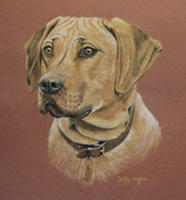
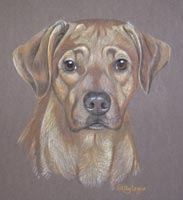
Rhodesian/ South African Ridgeback Portraits by Sally Logue
Search the Dog Portrait Galleries for more ridgebacks
Search for More Dog Breeds
Breed Information - Rhodesian Ridgebacks
The Rhodesian Ridgeback is a powerful animal but is non-aggressive. Loyal and affectionate to its family but wary of strangers. A good guard but only barks when necessary.
Description & History
The Rhodesian Ridgeback originated in South Africa - not in Zimbabwe. The breed, once known as the African Lion Dog, is descended from the ancient Hottentot Ridged Dog and has been in existence for hundreds of years. Boer farmers crossed the Ridgeback with Bloodhounds and possibly Greyhounds.
European settlers took the breed to Rhodesia, where it was further developed. In 1922 a meeting was held in Bulawayo to standardise the breed. Several owners discussed what they considered to be the ideal dog. As a result of this meeting the breed standard was set - and still stands to this day.
They are fine muscular scent and sight hounds with great endurance, which were used for lion and big game hunting. These hounds, which are brave but not foolhardy, would track their prey and drive them towards the hunter. They have also been used to flush smaller game, such as rabbits, which they drive into nets.
In South Africa in the 1950's they were successfully used as gundogs. In Australia some years later, the breed, which is extremely fast, was used for racing. Some Ridgebacks are now being raced on Greyhound tracks in England and are proving to be as fast, if not faster, than Greyhounds.
Since the early part of the 1990's some British police forces have made attempts to train a few members of the breed. This was at first unsuccessful as the dogs lost interest in their work when it became repetitive. However, the Somerset and Avon Police Dog Section have now been successful in training a dog called Spike. He apparently completed his training in record time and is now on duty with his handler PC Howard.
The breed has a distinctive feature, which is a ridge of hair which grows in the opposite direction to the rest of the coat. It starts behind the shoulders and runs in a tapering line along the centre of the back up to the hip bones. Two identiical crowns, placed opposite each other, lie either side of the ridge just behind the shoulders.
A breed which should be preferably owned by experienced handlers.